
What Are Bare Metal Infrastructure Pipelines?
- Kiera Quinn
- -
- Bare Metal Automation
What if your automation isn’t actually helping you move faster? Platform engineering and virtualization Ops teams usually find this out the hard way. Bespoke scripts accumulate, playbooks multiply, and each environment ends up with its own “special” version of automation that only one engineer fully understands. What began as a solution to save time can become the very factor that slows the organization down.
At a small scale, this fragility might be able to be overlooked. However, as operations expand across data centers, vendors, and continents, the problems become more evident. A firmware mismatch at one site or a network dependency at another can cause the entire automation chain to come to a halt.
Each fix leads to the creation of another script, and with each script, the divergence from the standard increases. What’s labeled as “automated” can start to seem suspiciously manual.
Automation should reduce toil and technical debt. Time and time again, we see examples of deploying platforms and processes manually to revisit automation later, but later never seems to arrive. Martin Fowler appropriately wrote about this challenge, describing it as a Technical Debt Quadrant all the way back in 2009. There is a marked difference in the long-term results when you plan and automate early.
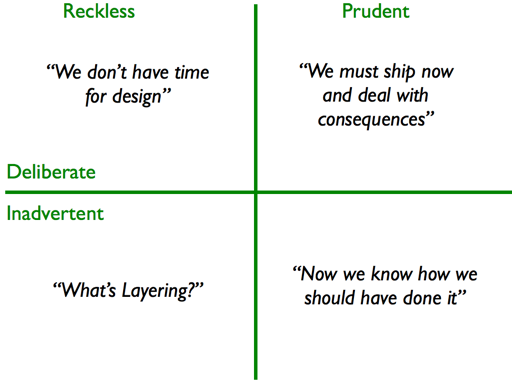
The fact is that IT automation doesn’t fail due to a lack of tools; it fails because of a lack of structure. Just as CI/CD pipelines have revolutionized how developers deploy software, Infrastructure Pipelines are transforming how operations teams build, maintain, and manage both physical and virtual infrastructure.
How can SREs, platform engineers, and Ops teams bring order to chaos, enabling consistency, governance, and speed across every site, vendor, and team?
Let’s find out!
The Problem: Automation Doesn’t Scale Without Structure
For most IT operations teams, automation evolves organically. IT operations teams write scripts to fix an urgent problem, then copy and customize across sites. Over time, each data center or region develops its own flavor of automation, unique configurations, vendor-specific tools, and incompatible processes. This patchwork works fine for a handful of servers, but breaks under the weight of global operations.
The pain multiplies with each new site. A configuration that succeeds in one region may fail in another due to differences in the OEM, firmware version, or network policy. Teams waste countless hours troubleshooting instead of delivering.
The result is a familiar pattern: fragmented tools, inconsistent results, and ungoverned infrastructure drift. It becomes more obvious as we visualize the number of people, tools, components, and handoffs in the process.
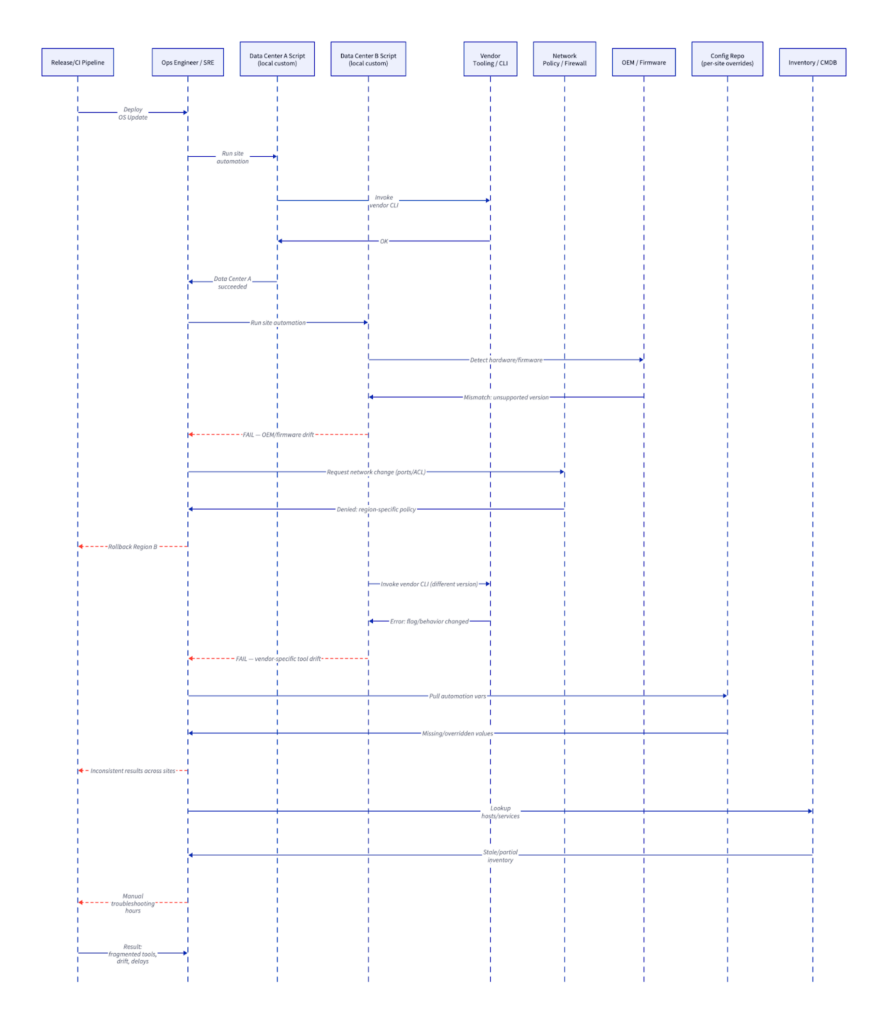
Scaling automation requires more than technical skill; it demands discipline. Enterprises need a repeatable framework that encodes best practices, enforces governance, and synchronizes operations across every site and vendor. Infrastructure Pipelines provide exactly that structure.
What Are Infrastructure Pipelines?
Infrastructure Pipelines bring the discipline of CI/CD into the world of infrastructure, creating automated, version-controlled workflows that provision, validate, and manage both physical and virtual environments with precision and repeatability.
Each stage of the pipeline represents a specific step: discovering hardware, configuring BIOS and RAID, installing operating systems, applying security baselines, validating compliance, and then integrating seamlessly with Infrastructure-as-Code and orchestration tools, such as Terraform, OpenTofu, or Ansible, to enable complete, end-to-end infrastructure automation. Since the process is codified, every build is predictable, traceable, and repeatable.

The key difference between Infrastructure Pipelines and traditional Infrastructure-as-Code is the control over the lifecycle. IaC tools are effective at describing end states, but they depend on external systems to manage real-world dependencies, such as power control, firmware updates, and hardware resets. Infrastructure Pipelines address this gap by integrating event-driven workflows that dynamically respond to hardware states, ensuring consistency from provisioning to retirement.
In summary, Infrastructure Pipelines transform infrastructure management from a series of isolated tasks into a continuous process that is automated, auditable, and globally scalable.
From Scripts to Pipelines: The Automation Maturity Journey
Most organizations move through three stages on the road to infrastructure automation maturity:
- Scripting: Individual engineers write scripts to automate repetitive tasks. Useful locally, but fragile and unscalable.
- Infrastructure-as-Code: Tools like Terraform and Ansible introduce structure, allowing environments to be declared in code. However, they still depend on manual setup and don’t manage state across hardware events.
- Event-Driven Pipelines: Automation Evolves into a Fully Orchestrated System. Pipelines manage provisioning, configuration, validation, and rebuilds automatically, detecting drift, enforcing policy, and providing full lifecycle visibility.
This final stage is where RackN’s Digital Rebar Platform comes in. It acts as the engine for these event-driven, multi-site pipelines, providing infrastructure teams with the same automation maturity that DevOps has brought to software delivery.
How RackN Digital Rebar Powers Infrastructure Pipelines
RackN Digital Rebar is much more than just a provisioning tool. It’s a comprehensive automation framework designed for the realities of hybrid and multi-vendor infrastructures. RackN Digital Rebar provides the pipeline fundamentals that connect your existing automation stack into a single, coherent system.
Our goal is to manage bare metal infrastructure with the same, or greater, level of flexible automation that powers today’s cloud infrastructure.
To do this, our key capabilities include:
- Event-Driven Workflows – Digital Rebar automatically triggers actions based on infrastructure state, boot events, failures, or configuration changes, keeping pipelines responsive and resilient.
- Lifecycle Management – Every node can be rebuilt, patched, or decommissioned automatically, ensuring continuous compliance and eliminating manual toil.
- Multi-Vendor Orchestration – From hardware OEMs like Dell, HP, and Supermicro to operating systems and virtualization platforms such as RHEL, ESXi, and OpenShift, Digital Rebar orchestrates diverse environments through standardized APIs. This eliminates the need for custom scripts and ensures consistent automation across the entire stack.
- Patented Multi-Site Manager – Enables global operations to manage hundreds of distributed data centers as one logical infrastructure.
- Governance and Compliance – Every step is logged, versioned, and validated, enabling enterprises to meet audit and security requirements without incurring additional manual overhead.
For example, RackN Infrastructure Pipelines enable continuous compliance by ensuring every server is provisioned and validated identically, every time. Instead of spending hours rebuilding failed clusters or tracking configuration drift, IT operations teams simply rerun a pipeline, and the system automatically restores itself to a known good state.
Scaling IT Automation: Real-World Impact
The measurable impact of Infrastructure Pipelines can be significant. It can:
- Reduce up to 90% manual rebuild effort.
- Faster onboarding of new infrastructure across global sites.
- Improve auditability through centralized lifecycle logs.
- Reduce configuration drift and fewer failed deployments.
A striking real-world example comes from a major global bank that used RackN’s Digital Rebar to complete a full refresh of 40,000 servers across eight data centers in just six weeks. By utilizing vendor-neutral automation and the Multi-Site Manager to orchestrate the rollout, the bank achieved significant cost savings, reduced its data center footprint, and improved performance, all without requiring custom code or a large consulting team. The secret wasn’t bespoke scripts; it was the discipline of a well-defined infrastructure pipeline.
Other RackN customers have reported similar gains. One gaming enterprise reduced manual operations time by 83% by standardizing its provisioning workflows across thousands of servers. In every case, the result was the same: faster outcomes, lower costs, and greater confidence in automation.
Why “Ops as a Consultant” Matters
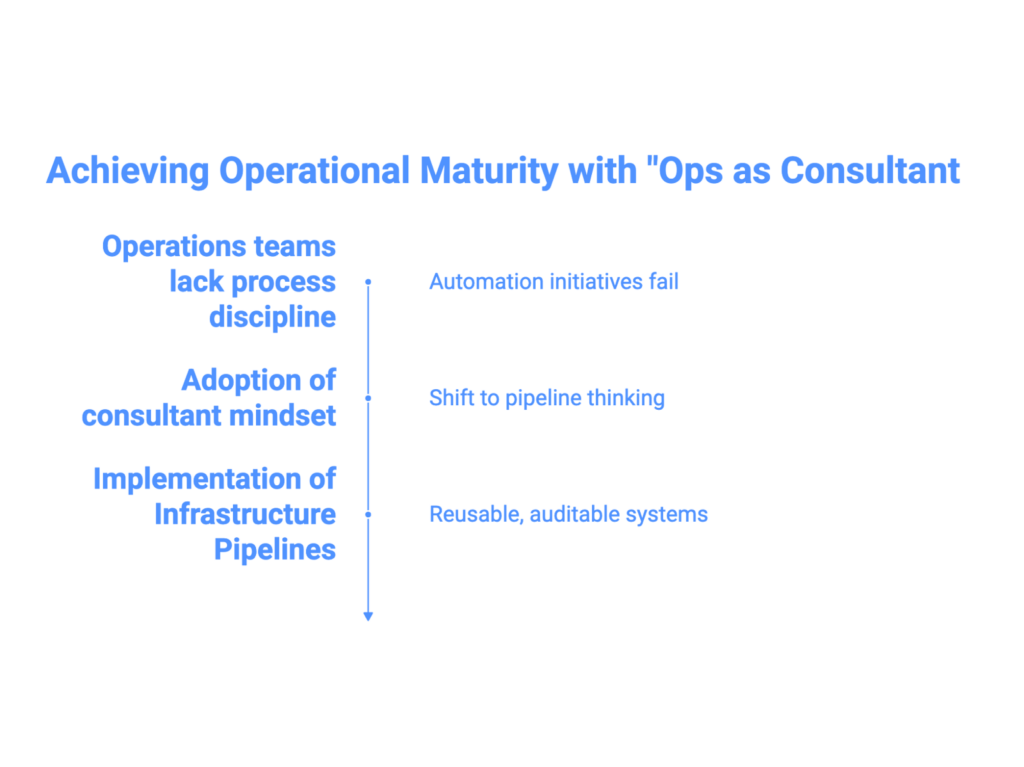
At RackN, we’ve seen countless automation initiatives fail. It’s not because the operation teams lacked tools but because they lacked process discipline. True scale doesn’t come from stacking more software on top of brittle workflows; it comes from treating operations like an internal consulting function, focused on standards, repeatability, and measurable outcomes.
When internal IT teams adopt the consultant mindset, they stop thinking in terms of “one-off installs” and start thinking in terms of pipelines. Each change, whether a new rack, a firmware upgrade, or an OS rebuild, flows through the same governed process. This approach accelerates delivery and creates institutional trust in the automation itself.
Infrastructure pipelines change you to providing infrastructure services instead of servers. They turn day-to-day operations into reusable, auditable systems that continuously improve over time, laying the groundwork for true operational maturity.
Conclusion: Build Automation That Scales
Automation isn’t just about speed; it’s about control, trust, and scale. As enterprises expand across multiple data centers, cloud regions, and hardware vendors, the traditional approach of managing scripts and spreadsheets becomes increasingly complex. Bare Metal Infrastructure Pipelines are the answer: they bring the discipline of DevOps to the world of infrastructure, enabling operations teams the consistency and confidence to move faster than ever before.
RackN Digital Rebar Platform brings that vision to life. With event-driven workflows, lifecycle management, vendor neutrality, and the patented Multi-Site Manager, RackN helps global enterprises build Infrastructure Pipelines that are as reliable as the applications they support.
Stop treating automation as a collection of scripts; build it as a system. RackN Infrastructure Pipelines help you automate everything from provisioning to compliance at enterprise scale.
To learn more, schedule a demo to see how RackN Digital Rebar can transform your global operations, or engage RackN for a pilot program to start building your Infrastructure Pipeline today.
Infrastructure Pipelines FAQs
What problem do Bare Metal Infrastructure Pipelines solve?
Bare Metal Infrastructure Pipelines solve the problem of fragmented and inconsistent automation across multiple data centers, vendors, and environments. Instead of relying on isolated scripts and manual processes, Infrastructure Pipelines create a unified, repeatable system that automates every stage of infrastructure lifecycle management from provisioning and compliance to rebuilds and retirement.
How are Infrastructure Pipelines different from Infrastructure-as-Code (IaC)?
While Infrastructure-as-Code tools like Terraform or Ansible define what an environment should look like, Infrastructure Pipelines define how it gets built, validated, and maintained. Pipelines add lifecycle awareness, managing dependencies like firmware updates, power control, and rebuilds through event-driven automation.
How does RackN Digital Rebar enable Infrastructure Pipelines?
RackN Digital Rebar Platform serves as the automation engine behind Infrastructure Pipelines. It connects provisioning, configuration, and compliance into a single event-driven framework that spans vendors and geographies. With patented features like Multi-Site Manager, lifecycle automation, and vendor-neutral orchestration, Digital Rebar allows enterprises to manage thousands of servers across global data centers as easily as a single site, achieving true infrastructure automation at scale.

Digital Rebar v4.16 Release Notes

The Challenges of Kubernetes on Bare Metal

Why Bare Metal Governance Matters More Than Virtualization Strategy