
One of the world’s largest hyperscalers was burning $150K+ every time they needed to reset a 64-node AI training cluster because it took 7 days with industry-standard tools. Through using out-of-the-box Infrastructure Pipelines from RackN’s Digital Rebar, they cut that to 90 minutes while achieving true zero-touch operations at scale. This isn’t just fast provisioning, it’s end-to-end automation to keep up with the speed AI development demands.
The $22,000 Per Day Cluster Reset Problem
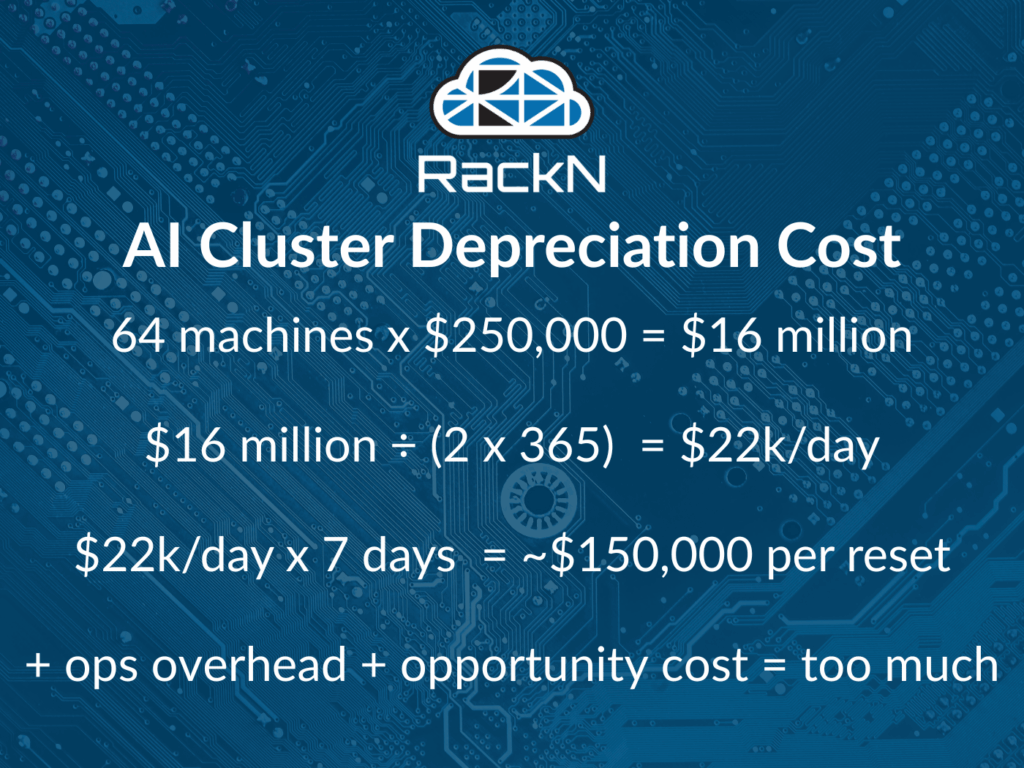
A single 64-machine GPU training cluster, at $250,000 a machine, costs around $16 million. Over a two-year depreciation cycle, that’s roughly $22,000 per day.
When one of the world’s top hyperscalers came to us, they were facing a 7-day cluster reset window between AI training workloads. That’s around $150K in depreciation per reset, not counting ops overhead or opportunity costs. At that pace, shared training clusters become economically impractical.
Reset at AI Speed
The traditional approach to bare metal automation was built for an era when hardware was relatively stable and workloads changed quarterly, not daily. That model breaks down completely in AI environments.
Using Digital Rebar with out-of-the-box Infrastructure Pipelines for AI, this hyperscaler built a fully automated process that treats every reset like a fresh deployment.
Included in every refresh:
Secure wipes and pristine restoration. The system is wiped of sensitive data and returned to a known-good state.
Full reconfiguration. BIOS, RAID, firmware, and networking get reconfigured and updated on every reset. This enforces consistency at the hardware layer, ensures there’s no configuration drift, and keeps everything up-to-date.
Parallel pod provisioning. All 64 nodes in a GPU training pod are provisioned simultaneously, including complex storage and fiber-channel networking.
Zero-touch automation. The entire process runs without human intervention.
The industry standard for this kind of reset is 7 days. And for new hardware onboarding it’s 2 weeks. However, these timelines just don’t work when AI development cycles move at the speed they do today.
Security Meets Specialized Hardware
AI training workloads handle sensitive data. Every machine must be completely scrubbed between jobs with full secure wipes and BIOS resets.
The hardware requirements make it even more challenging, needing hyper-dense servers with specialized NICs and the latest generation GPUs. These components have high patch rates and failure frequencies. And this entire operation was happening at a third-party GPU cloud provider where true zero-touch was the only way to operate.
The Results
Cluster reset time: 90 minutes, down from 7 days.
New hardware onboarding: 4 hours, down from 2 weeks, including automated validation and burn-in.
This approach proved itself at both pod-level deployments (64 nodes) and full data center operations. The customer regularly performs complete data center repaving of over 4,000 servers simultaneously. All zero-touch, all automated, all achieving the same consistency guarantees.
Every cycle enforces firmware consistency, topology verification, and configuration standards. There’s no configuration drift because the process doesn’t allow it while remaining flexible enough to handle heterogeneous hardware reliably.
The Layer Everyone Ignores in AI Data Centers
Everyone talks about model performance, GPU utilization, and training throughput. Those metrics matter, but they’re meaningless if you’re bottlenecked at the infrastructure layer.
If you can’t rapidly provision and reprovision your infrastructure, you’re constrained before you even start model training. Your data scientists are stuck waiting on infrastructure, your security teams are manually verifying wipes, and your operators are babysitting firmware updates.
This hyperscaler achieved something most organizations think is impossible: an infrastructure lifecycle that keeps pace with AI development cycles while maintaining enterprise-grade security and reliability. They did it by treating Infrastructure as Code and leveraging reusable automation pipelines.
When you can reset a $16 million cluster in 90 minutes instead of 7 days, you unlock entirely new operational models. Shared training infrastructure becomes economically viable. Security requirements become enforceable, not aspirational. Hardware upgrades become routine, not projects.
That’s the difference between infrastructure that enables AI development and infrastructure that constrains it.
Now it’s Your Turn
If your team is struggling with AI workloads, bare metal automation, or trying to move faster than your legacy provisioning tools allow, Digital Rebar is the solution.
What’s your biggest infrastructure automation bottleneck? Schedule a demo and let’s talk about it.