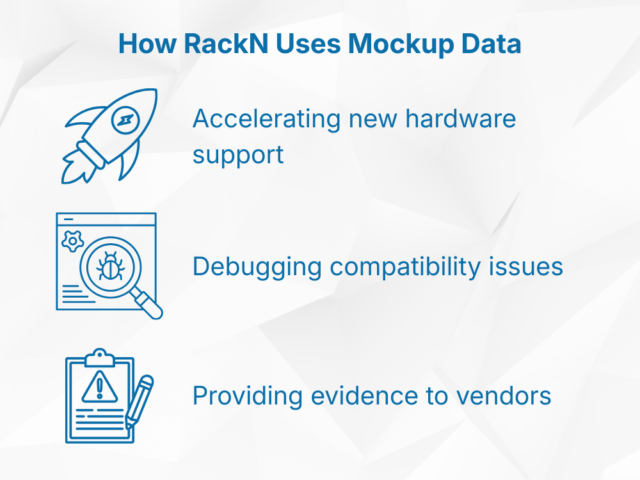
Accelerating new hardware support. When a customer gets a new server generation that Digital Rebar hasn‘t seen before, the old process was slow: reproduce the issue, acquire lab hardware, debug blind. With mockup capture, a customer can run one command and send us the resulting archive. Our engineering team has an exact replica of the hardware‘s management interface within minutes. No shipping hardware, no waiting for lab access, no back-and-forth trying to describe what an endpoint returns. We can typically turn new hardware compatibility from a multi-week process into days.
Debugging compatibility issues. When automation breaks on a specific server or firmware version, like the iDRAC 10 situation, the mockup tells us precisely what the BMC is returning. We’re not guessing based on a customer’s description. We see the actual responses, including the exact fields, error codes, and headers. That makes root cause analysis dramatically faster and eliminates the “works on our end” problem entirely.
Providing evidence to vendors. When a vendor’s implementation doesn’t match the specification, or when something changes between firmware versions without documentation, vendors naturally want to see proof. A mockup is irrefutable. We can extract exactly the endpoint in question, show the response before and after the firmware update, and demonstrate precisely where the behavior diverged. That’s a much more
productive conversation than a bug report saying “boot order is broken.”
The Value of Sharing Mockups with RackN
The server hardware landscape is vast. Even within a single vendor‘s product line there are dozens of generations and firmware versions each potentially behaving differently from the last. No support team can have lab access to every combination.
That is what makes the mockup so valuable when you need help. When you open a support ticket with RackN and attach a mockup, you give RackN an exact replica of the hardware‘s management interface to work with. We can load it on our testing pipelines, reproduce the behavior you‘re seeing, and diagnose the issue without needing access to your environment or your physical hardware. Given the sheer number of hardware variations in the field, this cuts support resolution time significantly. Issues that would otherwise require physical hardware reproduction can often be diagnosed and resolved entirely from the mockup.
What Mockups Can‘t Do
A mockup is a snapshot in time, so dynamic behaviors like power state changes, firmware update job queues, and live sensor readings aren‘t fully captured. Real hardware is still needed for those scenarios. But the category of problem that most often causes automation failures is simpler: an endpoint doesn‘t behave the way you expected. For that, a mockup captures exactly the right information.
Staying Ahead of the Curve
Redfish is an evolving standard and its specifications and the hardware running it rarely move in lockstep. Some vendors move ahead or even drive the current specifications, adopting new behaviors before they‘re officially released. Others lag behind, staying on older implementations long after the specifications has moved on. Both situations are normal, and both create compatibility gaps that operations teams have to manage.
What changes is your ability to respond. With getRedfishMockup built into Digital Rebar, every server in your infrastructure is one command away from producing the data that RackN needs to support it, debug it, or make the case to the vendor when something is wrong.
If you‘re a RackN customer running Redfish–capable hardware, try it today. If you hit any hardware that doesn‘t behave as expected, capture a mockup and open a support ticket. You‘ll be surprised how fast we can move when we have the full picture.